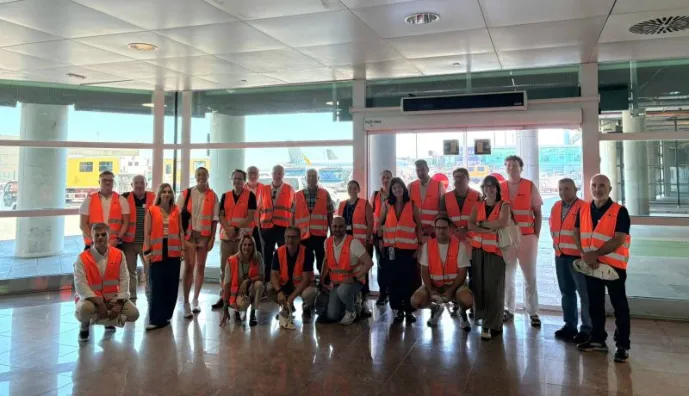
The members of the Tech Tourism Cluster and the Light Mobility Cluster have visited the facilities of the Aeroport Josep Tarradellas Barcelona-El Prat to learn firsthand how technology, data, and innovation contribute to the operation of one of the main mobility infrastructures in Southern Europe.
The event, organized in collaboration with Aena, provided an opportunity to discover the processes, systems, and spaces that usually remain out of passengers' sight, as well as to learn about the initiatives that are transforming the airport experience and preparing the airport for future challenges.
With over 58 million annual passengers and connections to 221 destinations, the Josep Tarradellas Barcelona-El Prat Airport has established itself as the seventh busiest airport in Europe by passenger volume. This scale makes the use of advanced technologies essential to ensure efficient, secure operations capable of managing millions of movements each year.
During the visit, attendees learned about Aena's Strategic Plan for Innovation and Digital Transformation, a strategy focused on integrating technology across all areas of airport activity. Key lines of action include data integration to personalize passenger services, the implementation of platforms based on the Internet of Things (IoT) and artificial intelligence to optimize operations, and the development of new initiatives tied to sustainable mobility and the digitalization of services.
One of the highlights of the day was gaining access to various restricted areas of the airport, which provided insight into the complexity of the operations behind every flight. Participants visited the Automated Baggage Handling System (SATE), a key infrastructure for the airport's logistics management. In Terminal 1 alone, this system processes nearly 35,000 bags a day through an extensive network of conveyor belts and a process that incorporates five levels of control and security before the luggage reaches the aircraft.

The visit also included access to the Control Room, considered the nerve center of the airport. From this space, operations are monitored in real time, passenger flows are coordinated, and the main systems ensuring service continuity are supervised.
Finally, the tour of the runways allowed a close-up look at the logistics that make every takeoff and landing possible, as well as the coordination among the different teams involved in airport operations.
Beyond showing the airport's current operations, the event also shed light on some of the projects that will shape its evolution in the coming years. Among the main challenges outlined were the expansion of the third runway, the future rail connection to Terminal 1, and the decarbonization strategy driven by Aena, which aims to achieve climate neutrality by 2030.
We would like to thank Aena and, especially, Irene Floro, for their hospitality and willingness to share knowledge with the companies of both clusters.
Author

Recent posts

08 October 2026

08 October 2026

07 October 2026

07 October 2026
Subscribe
Subscribe here and stay tunned on what's next