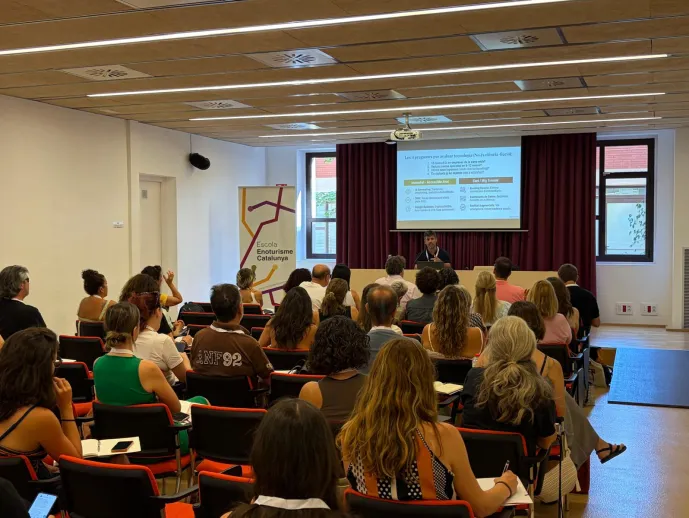
The Wine Tourism School of Catalonia (Escola d’Enoturisme de Catalunya) held its first working session yesterday to advance the creation of the future Wine Tourism Innovation Hub, an initiative organized jointly with Tech Tourism Cluster and INNOVI, in collaboration with ACCIÓ. The event also featured the participation of the Barcelona Travel Hub, which delivered an inspiring talk to share experiences and benchmark models in building innovation ecosystems.
The session brought together around forty professionals from 38 companies and organizations linked to the wine sector, representing all the main producing areas of Catalonia. Attendees included wineries, service companies, promotional bodies, specialized consultancies, territorial entities, and other agents related to wine tourism.
The main objective of the meeting was to validate the initial diagnosis of the current state of innovation in Catalan wine tourism and to incorporate the vision of industry professionals to guide the Innovation Hub's next lines of work. To achieve this, participants were divided into seven working groups led by representatives from INNOVI, ACCIÓ, the Tech Tourism Cluster, the Barcelona Travel Hub, and the Wine Tourism School of Catalonia.
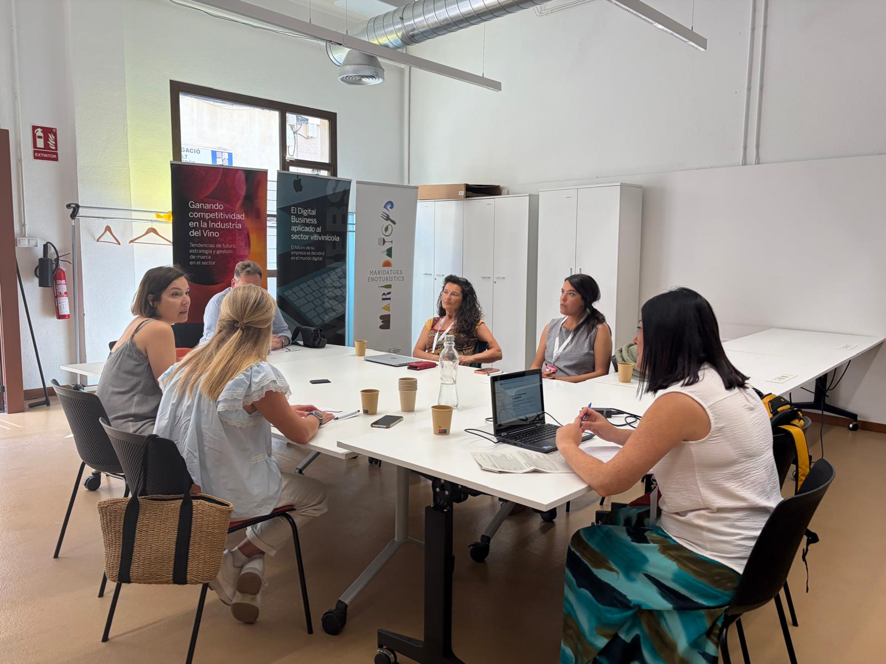
Throughout the different sessions, some of the main challenges facing the sector were identified, such as defining a shared innovation strategy, strengthening digital skills, establishing better connections with research and technology centers, preparing for new future scenarios, and attracting and retaining qualified talent.
One of the most significant conclusions was that innovation in wine tourism goes far beyond the adoption of new technologies. Participants highlighted the importance of transforming aspects such as the storytelling of experiences, marketing strategies, collaboration between regions, sustainability, accessibility, the professionalization of services, and the design of unique, distinctive experiences for visitors.
Digital transformation also took center stage in the debate. Tools such as online booking systems, CRMs, data analysis, digital communication, and artificial intelligence were discussed. There was a consensus that these technologies should serve as a support tool to optimize management and enrich the visitor experience, while always preserving the value of personal interaction—one of the greatest assets of wine tourism.
The session also underscored the need to strengthen collaboration among companies, public administrations, clusters, universities, technology centers, and educational institutions. In this context, the future Innovation Hub is being created with the aim of becoming a permanent space for cooperation, knowledge exchange, and the promotion of shared projects, providing the sector with access to tools, data, best practices, and new innovation opportunities.
This first session marks the starting point of a participatory process that will continue over the coming months with new phases of work. The objective will be to identify solutions, establish priorities, and develop concrete initiatives that help drive the competitiveness and evolution of wine tourism in Catalonia.
Author

Recent posts

23 September 2026


Subscribe
Subscribe here and stay tunned on what's next