On 7 September, the Tech Tourism Cluster held a new session of the TechTur Legal Series, together with MyLegalInbox and Codurance, to address an increasingly relevant question for tourism companies: what does the AI Act really mean, and how can we go beyond simply complying with it?
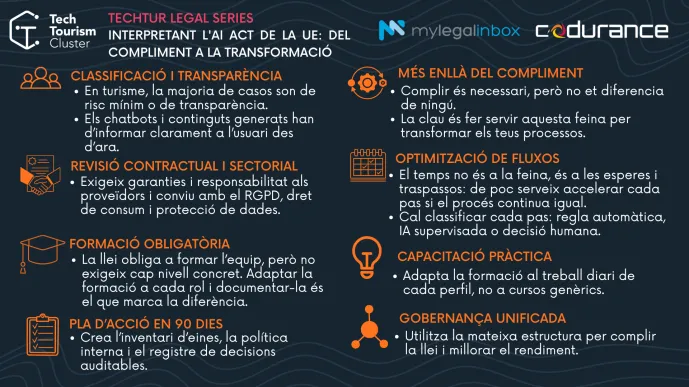
The session brought together two perspectives. On the one hand, Borja Rivas, from MyLegalInbox, explained the main obligations that the AI Act entails for companies. The first step? Understanding which AI is actually being used within the organisation: chatbots, pricing engines, recommendation systems, content generation tools or internal tools, among others. From there, companies need to identify their level of risk and apply the appropriate measures.
In the tourism sector, most uses fall within minimal-risk levels or involve transparency obligations. For example, chatbots must clearly inform users that they are interacting with AI and provide a way to escalate the interaction to a person. It was also highlighted that the AI Act coexists with other regulations, such as the GDPR, and that working with an AI provider does not exempt a company from its responsibilities: contracts, safeguards and what happens if the model changes all need to be reviewed.
But the session also highlighted a key idea: compliance is necessary, but it is not enough to stand out. As Lesmes López, from Codurance, explained, introducing AI is a good opportunity to review a company’s processes rather than simply speeding up the way things are currently done. The recommendation is to start with processes involving multiple handovers, waiting times or reviews, and analyse which tasks can be automated, which can benefit from supervised AI and which decisions should remain in human hands.
The session also focused on training, which should be adapted to each person’s role within the process rather than being limited to generic artificial intelligence courses.
Ultimately, the session left us with a clear idea: the governance required by the AI Act can also provide the same structure a company needs to move forward with its AI transformation. Identifying the tools already in use, reviewing processes, assigning responsibilities and documenting decisions are steps that help companies comply, but also begin to transform the way they work.
Another session of the TechTur Legal Series to better understand regulatory changes and, above all, turn them into opportunities for practical application within the tourism sector.
Thank you to Lesmes López from Codurance and Borja Rivas from Mylegalinbox, for such a clear and useful session, helping us understand how to turn compliance into an opportunity for transformation.
Author

Project Manager
Recent posts

07 October 2026

23 September 2026


Tags
-
Events
Subscribe
Subscribe here and stay tunned on what's next