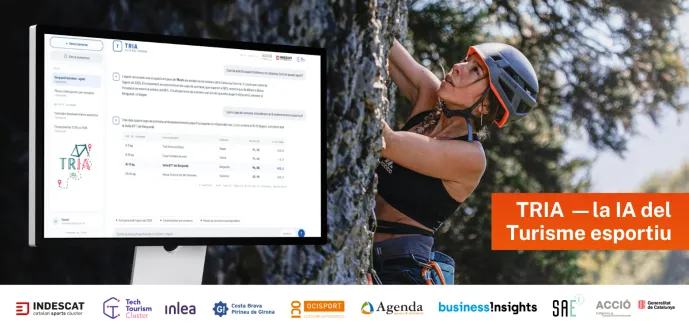
TRIA advances in the development of an initial AI application for sports tourism
The TRIA – AI for Sports Tourism project has completed the first phase of its technological development with the creation of a preliminary version of its application. The initiative explores how AI and the integration of different data sources can facilitate access to relevant information for professionals in the sports and tourism sectors.
This initial version has been conceived as a pilot test to begin validating the technological approach, the tool’s usability and the information sources that could prove most useful. It is therefore not yet a final application, but rather an initial solution that will be reviewed and improved based on the insights gained throughout the project.
An initial approach to connecting data from different fields
One of the main challenges facing sports tourism is the fragmentation of information. Data on sports activities, events, accommodation, healthcare services and visitor behaviour is scattered across numerous platforms and providers, making it difficult to consult and use collectively.
During this first phase of TRIA, nearly 40 providers and information sources related to areas such as sports, health and accommodation have been analysed. This work has made it possible to identify potentially relevant data, assess its availability and explore options for integrating it into the application.
Based on this analysis, an initial platform has been developed to explore the integration of anonymised data from different sources. The aim is to move towards a system that provides access to information on sports and tourism activity in a given area through a single environment.
Artificial intelligence to support decision-making
TRIA is based on the concept of an artificial intelligence “super-agent”: a system that interacts with users while also connecting to different specialised information sources.
In future phases, this approach could help identify activity patterns, provide a better understanding of sports tourists’ profiles and needs, and facilitate resource planning. This information could be useful for event organisers, destinations, accommodation providers, sports companies and other stakeholders involved in sports tourism.
Potential applications being explored include event planning, forecasting logistical requirements, identifying trends and coordinating services related to the arrival of athletes and their companions.
A pilot focused on sports tourism in Girona
The pilot test focuses on the Girona area, particularly on activities related to cycling and triathlon. This setting makes it possible to analyse the needs of an area with a significant concentration of sports and tourism activity, while bringing together the perspectives of event organisers, businesses, destinations and technology providers.
The lessons learned from the pilot will help lay the foundations for TRIA’s potential future development and enable its application in other regions, sports or tourism contexts to be explored.
A collaborative, intercluster initiative
TRIA is an intercluster initiative led by INDESCAT and the Tech Tourism Cluster, with the support of ACCIÓ. The project brings together expertise in sports, tourism, technology and law through the participation of INLEA, Business Insights, the Costa Brava Girona Tourist Board, OCISPORT, Agenda Sports and SAEE Consulting.
The participating tourism and sports organisations help define future users’ needs and the application’s use cases. The technology partners are working on the architecture, data management, artificial intelligence agents and interface, while legal oversight addresses matters such as data protection and regulatory compliance.
This collaboration is essential to ensure that the technological development responds to real needs and takes into account the specific characteristics of both sectors.
Author

Recent posts

08 October 2026

08 October 2026

07 October 2026

07 October 2026
Tags
-
Projects
Subscribe
Subscribe here and stay tunned on what's next